
Long day care vs family day care: which fits your family
By Marcus Quinn · Updated 2026-08-06
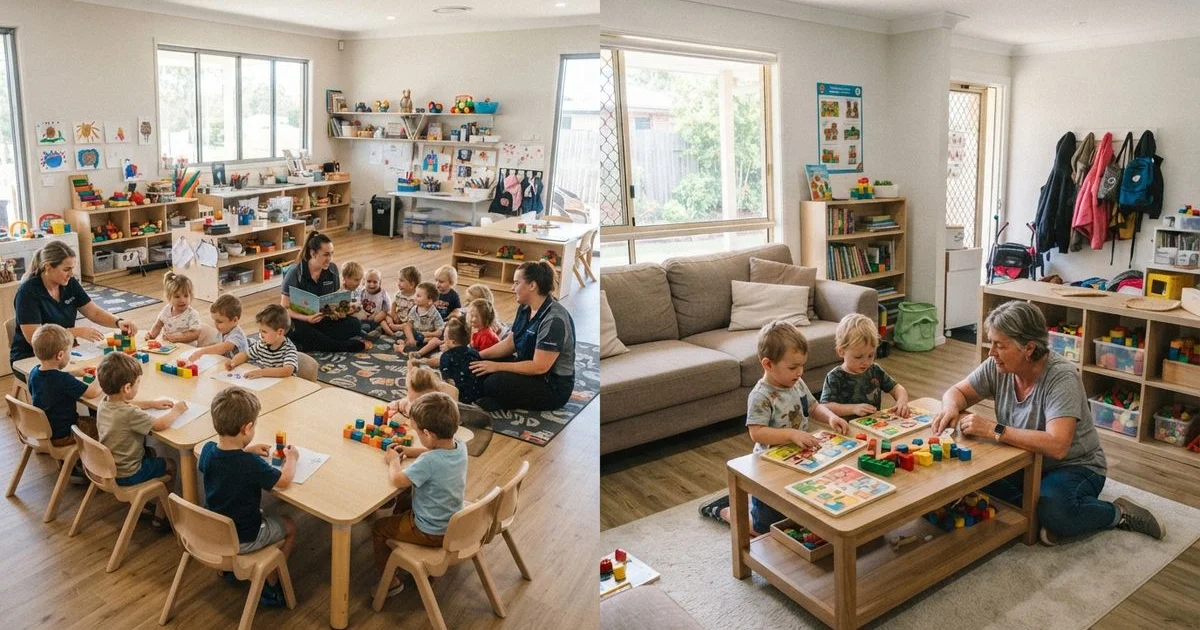
Neither option is objectively better. The right choice depends more on your child’s temperament, your routine, and what kind of environment you personally trust, than on any universal ranking between the two.
The core structural difference
Long day care runs from a purpose-built centre with age-grouped rooms and a rotating team of educators. Family day care runs from a registered educator’s home, typically with a smaller, mixed-age group and one consistent primary educator.
| Long day care | Family day care | |
|---|---|---|
| Setting | Purpose-built centre | Home-based |
| Group size | Larger, age-grouped rooms | Smaller, mixed ages |
| Staffing | Team of educators, some rotation | One primary educator |
| Hours | Set opening hours | Often more flexible |
| Typical daily fee | Slightly higher on average | Slightly lower on average |
| Backup if educator unavailable | Built into team structure | Depends on the family day care scheme’s backup arrangement |
For the dollar figures behind that fee row, see what childcare really costs in Redland Bay.
Where long day care tends to win
- Staffing depth. If one educator is unwell or on leave, a centre has a full team to draw on, so continuity of care is generally less disrupted.
- Age-specific facilities. Rooms and equipment are typically purpose-built for each age group, from baby rooms through to pre-kindy spaces.
- Structured programs. Larger centres often run more structured educational programs, with dedicated staff for planning.
Where family day care tends to win
- Smaller group, more individual attention. A lower child count per educator can mean more one-on-one time, particularly appealing for younger or more sensitive children.
- Flexibility. Many family day care educators offer more flexible hours than a centre’s fixed opening times.
- Sibling care together. Mixed-age groups mean siblings of different ages can often attend the same setting.
- A more home-like environment. For some children, a smaller, quieter, home-based setting eases the transition into care more gently than a larger centre.
What actually matters more than the format
Reviewing feedback across both care types, the details families care about most, consistent staff, clear communication, and children who seem genuinely happy to attend, show up in both settings when they are done well, and are missing in both when they are not. The format is a starting filter, not the final answer.
Trying before you commit fully
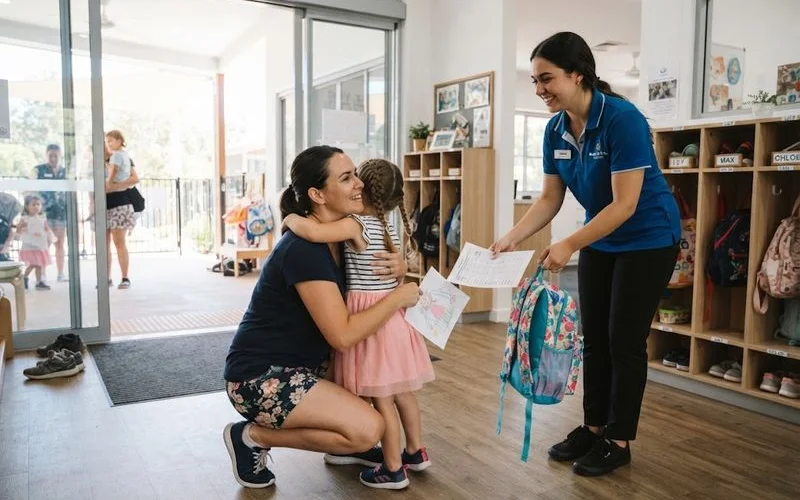
If you are genuinely torn, some families start with a lower number of days in one setting to see how their child responds before committing to a full week. This works better with family day care, where booking patterns tend to be more flexible, than with a centre, where a permanent enrolment is often needed to secure a place in a popular age group. Either way, ask directly what a trial or reduced-days start would look like before you commit to a full enrolment.
Making a later switch smoother
Many families move between the two over time rather than picking one for the whole preschool period. A common pattern is starting in family day care as a baby or toddler, where the smaller group suits a very young child well, then moving into a centre in the year or two before kindy, partly to help a child adjust to a larger group setting before school. If you are planning a switch like this, give yourself a few months of overlap where possible, so the new environment is not a completely new experience on the same day as everything else changes.
A simple way to decide
Ask yourself:
- Does my child do better in a smaller, quieter group, or are they comfortable in a bigger, more active setting?
- How much do I value staffing depth and backup versus a single, consistent educator?
- Does my routine need more flexibility than a centre’s fixed hours allow?
- Would my child benefit from being with siblings of a different age in the same setting?
There is no wrong answer here, only a better or worse fit for your specific family. Many families also change their mind over time, starting with one option and moving to the other as their child grows or circumstances shift.
Our ranking methodology scores both care types on the same criteria, so you can compare like for like. Start from the homepage to see every option across Redland Bay in one place.
Common questions
- Is one option generally cheaper than the other?
- Family day care daily fees tend to run a little lower than long day care on average, though it varies by educator and centre, so it is worth comparing actual quotes rather than assuming a fixed gap.
- Which is better for a baby under 12 months?
- Both can work well for babies. Family day care offers a smaller, more consistent group with one primary educator, while long day care offers dedicated baby rooms with staff trained specifically for that age group. It comes down to which environment suits your child.
- Can I switch from one to the other later?
- Yes, many families do, often moving from family day care to a centre before starting kindy, since a centre-based transition can ease the move into a larger group setting.
- Do both count toward the Child Care Subsidy the same way?
- Yes, both are approved care types under the Child Care Subsidy, so the same income and activity-based rules apply to either choice.